






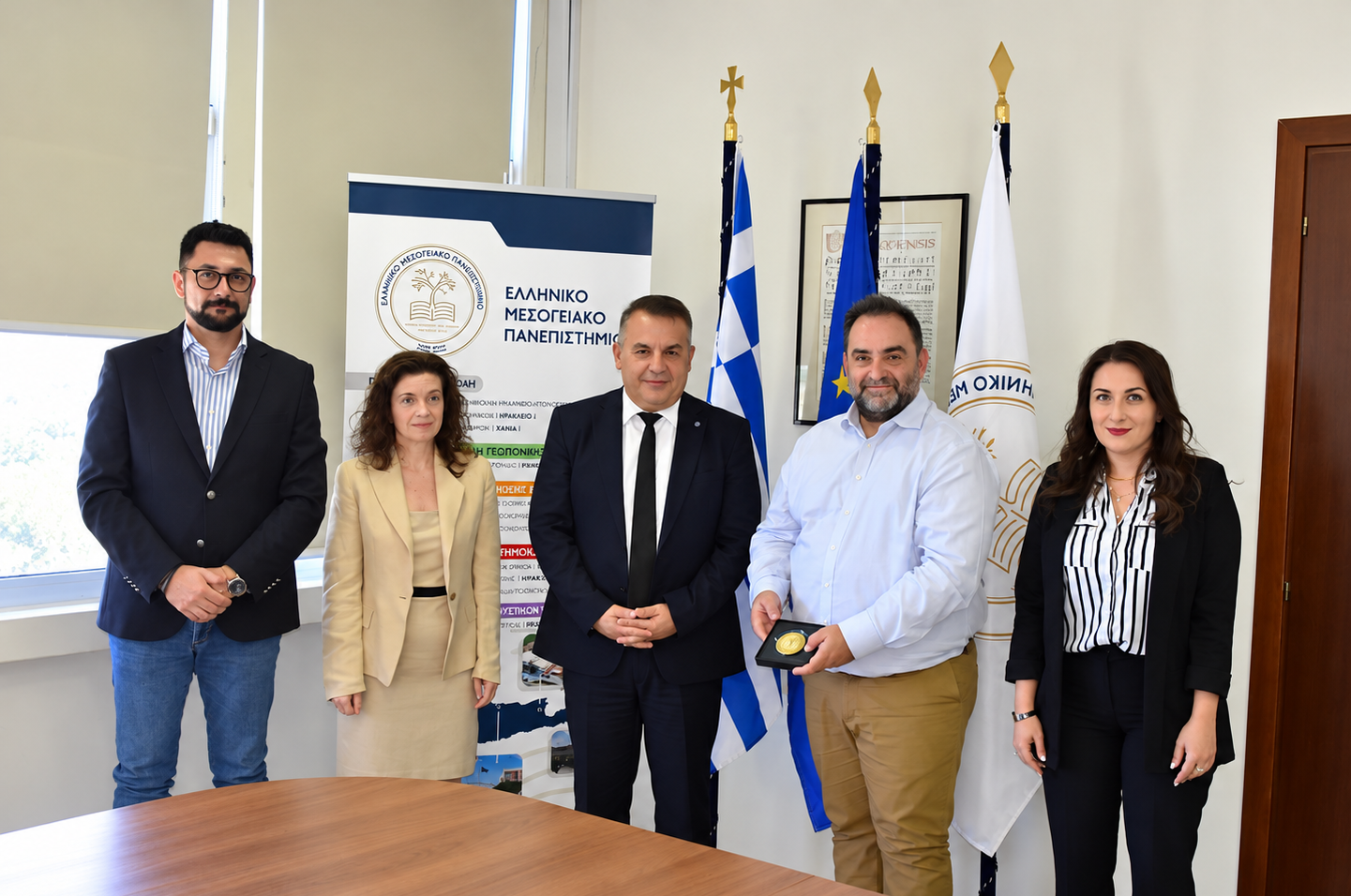
The Hellenic Mediterranean University (HMU) and GREEN EVOLUTION S.A. signed a Memorandum of Cooperation on Friday, 9 October 2026, establishing a framework for the development of joint scientific, research, educational and applied activities focused on linking the protection of cultural heritage with the sustainable management of tourism destinations.
The Memorandum was signed, on behalf of the Hellenic Mediterranean University, by the Rector, Professor Nektarios Papadogiannis, and, on behalf of GREEN EVOLUTION S.A., by its Chief Executive Officer, Dr Ioannis Pappas. GREEN EVOLUTION provides services in the fields of environment, energy and sustainability.
Also participating in the meeting on behalf of HMU were Associate Professor Alexandros Garefalakis, Chair of the Department of Business Administration and Tourism of the School of Management and Economics; Associate Professor Eirini Papadaki of the Department of Business Administration and Tourism of the School of Management and Economics; and PhD Candidate Despina Tsavdaridou.
The main focus of the cooperation is the comparative analysis of the UNESCO frameworks and the GSTC Destination Criteria, with particular emphasis on the relationship between culture, sustainability and contemporary tourism destination management. The Memorandum provides for the development of a scientifically substantiated and practically applicable framework linking cultural heritage protection with sustainable tourism development, highlighting culture as a critical pillar of sustainability.
The cooperation will include, among other activities, the mapping and alignment of UNESCO and GSTC criteria and thematic areas, the development of a joint research methodology, the collection and scientific analysis of data, the preparation of case studies, scientific papers and presentations, as well as the formulation of practical recommendations for tourism destinations. Opportunities will also be explored for submitting joint research or European project proposals and for involving students and researchers in individual activities.
Dubrovnik is cited as an indicative case study, as a destination with a strong cultural and tourism identity through which the possibilities of linking international cultural heritage protection frameworks with sustainable tourism destination management criteria can be examined in practice.
GREEN EVOLUTION S.A., through Dr Ioannis Pappas, will contribute specialised expertise in the GSTC Destination Criteria, experience in sustainability assessments of tourism destinations, support in developing the comparative methodology, as well as connections with tourism destinations and international networks. HMU, for its part, will contribute academic and scientific expertise, literature review and comparative analysis of the UNESCO and GSTC frameworks, research methodology development, scientific data processing and co-authorship of scientific publications.
During the meeting, the Rector of HMU, Professor Nektarios Papadogiannis, emphasised the importance of achieving concrete and measurable results through collaborations developed within the framework of Memoranda, generating mutual benefits for the parties involved. As he noted, the objective is for the University’s institutional partnerships to be translated into meaningful actions through which both HMU and its partner organisations can make effective use of scientific knowledge, research experience and specialised expertise for the benefit of society and development.
For his part, the Chief Executive Officer of GREEN EVOLUTION S.A., Dr Ioannis Pappas, noted that the cooperation builds on work already initiated for Heraklion within the framework of the GSTC and can serve as a starting point for broader synergies with international networks seeking partnerships with academic institutions such as HMU. As he stated, the particularly innovative scope of the Memorandum seeks to connect the cultural dimension of a tourism destination, as reflected in UNESCO protection frameworks, with objective sustainability assessment criteria such as the GSTC Destination Criteria, with the aim of exploring how culture can contribute to the sustainable management and development prospects of a destination.
