

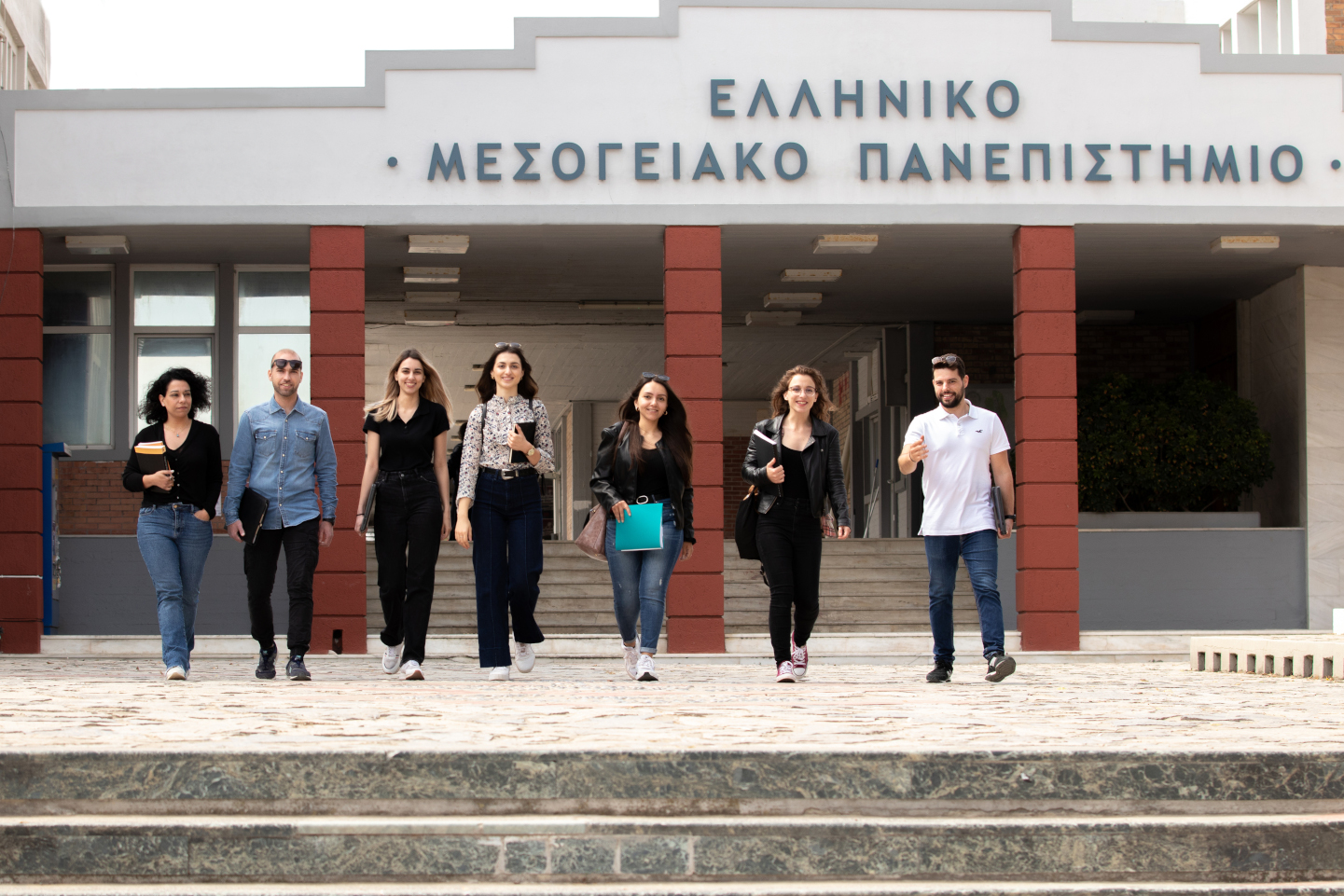



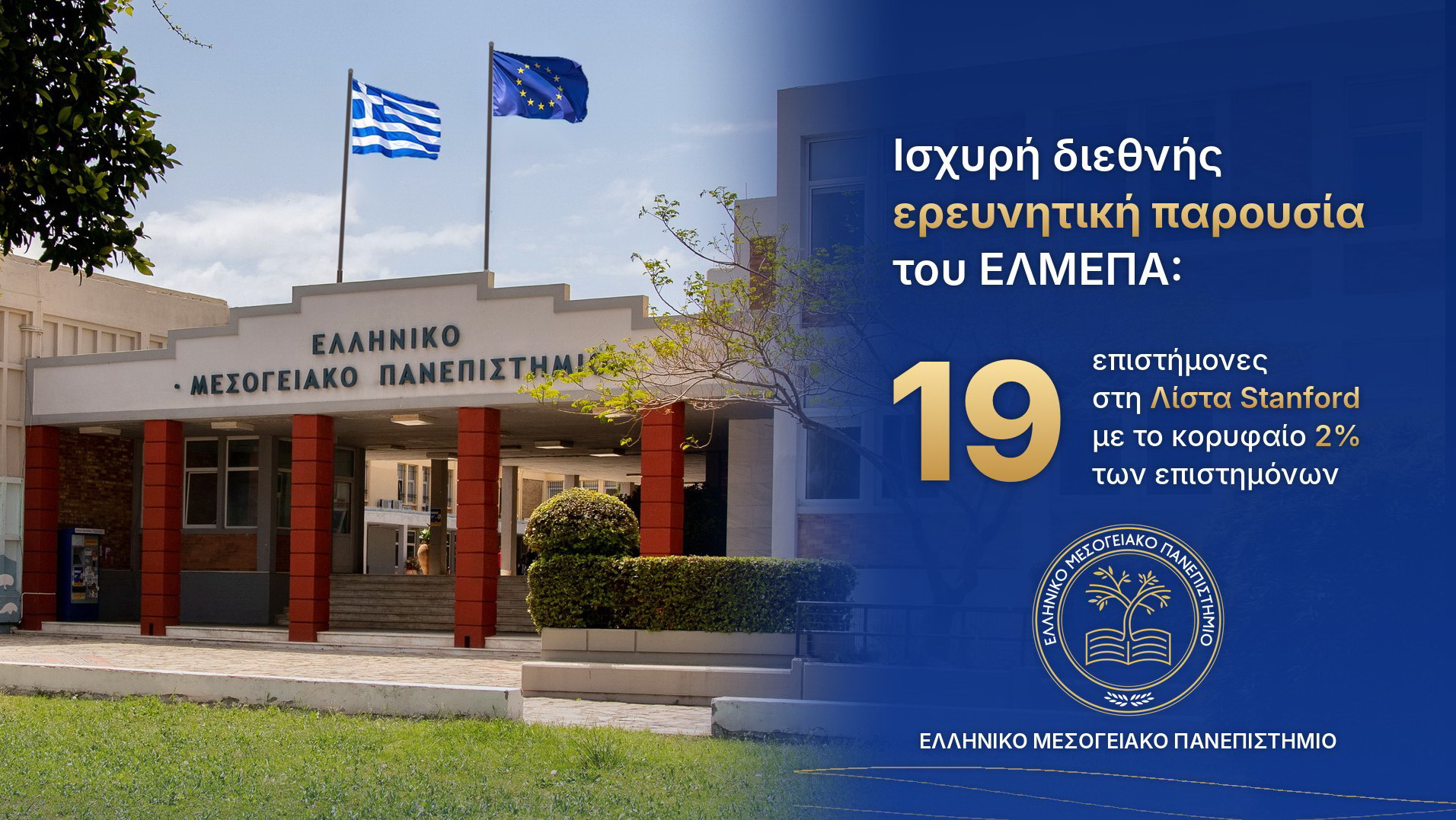
The Hellenic Mediterranean University (HMU) once again demonstrates a strong international research presence, with a total of 19 scientists from the University included in the updated international bibliometric database widely known as the “Stanford List.” The database is associated with the research team of Professor John P. A. Ioannidis of Stanford University and is published in the Elsevier Data Repository.
In this year’s edition, 15 HMU scientists are included in the ranking reflecting research impact during 2025 (single recent year), while 12 are included in the ranking reflecting the career-long impact of their scientific work (career-long). Eight researchers appear in both categories, bringing HMU’s overall representation to 19 individual scientists.
A particularly positive development in this year’s edition is the University’s stronger presence in the career-long category, which includes 12 HMU scientists, compared with 9 in the previous edition. This development reflects the University’s broader representation in the category measuring the long-term bibliometric impact of scientific work.
The 15 HMU scientists included for 2025
The ranking reflecting scientific impact during 2025 includes the following HMU scientists, in ranking order:
- Angeliki Menegaki – Department of Business Administration and Tourism
- Ioannis Passas – Department of Business Administration and Tourism
- Nektarios Vidakis – Department of Mechanical Engineering
- Ioannis Chatziantoniou – Department of Accounting and Finance
- Vasileios Raikos – Department of Nutrition and Dietetics
- Panagiotis Polygerinos – Department of Mechanical Engineering
- Dimitrios Kalderis – Department of Electronic Engineering
- Lazaros Tzounis – Department of Mechanical Engineering
- Markos Petousis – Department of Mechanical Engineering
- Dimitrios Katsaprakakis – Department of Mechanical Engineering
- Dimitra Vernardou – Department of Electrical and Computer Engineering
- Konstantinos Marias – Department of Electrical and Computer Engineering
- Georgios Chatzivasilis – Department of Electrical and Computer Engineering
- Dimitrios Fanourakis – Department of Agriculture
- Emmanouil Roditakis – Department of Agriculture
The 12 scientists with career-long research impact
The career-long ranking, which reflects the long-term bibliometric impact of scientific work through the end of 2025, includes:
- Angeliki Menegaki – Department of Business Administration and Tourism
- Emmanouil Kymakis – Department of Electrical and Computer Engineering
- Vasileios Raikos – Department of Nutrition and Dietetics
- Thrasyvoulos Manios – Department of Agriculture
- Dimitra Vernardou – Department of Electrical and Computer Engineering
- Ilias Potamitis – Department of Music Technology and Acoustics
- Dimitrios Katsaprakakis – Department of Mechanical Engineering
- Panagiotis Polygerinos – Department of Mechanical Engineering
- Nektarios Vidakis – Department of Mechanical Engineering
- Lazaros Tzounis – Department of Mechanical Engineering
- Konstantinos Marias – Department of Electrical and Computer Engineering
- Konstantinos Panagiotakis – Department of Management Science and Technology
The following scientists are included in both categories this year: Angeliki Menegaki, Nektarios Vidakis, Vasileios Raikos, Panagiotis Polygerinos, Lazaros Tzounis, Dimitrios Katsaprakakis, Dimitra Vernardou and Konstantinos Marias.
The Rector of the Hellenic Mediterranean University, Professor Nektarios Papadogiannis, warmly congratulates the 19 HMU scientists included in this year’s Stanford List, noting that the international recognition of their research constitutes a significant distinction both for the researchers themselves and for the University. HMU’s stronger representation in this year’s edition, particularly in the career-long category, reflects the steady progress of the University’s research activity and the continued strengthening of its international scientific presence.
The International Stanford List and its methodology
This year’s edition of the database, Version 9, was published on 7 October 2026 in the Elsevier Data Repository. It is based on Scopus data and provides standardized bibliometric indicators of scientific impact, including citations, the h-index, the co-authorship-adjusted hm-index, indicators accounting for authorship position in publications, as well as the composite c-score.
Scientists are classified into 20 scientific fields and 174 subfields. Selection for the published lists is based on the 100,000 scientists with the highest ranking according to the composite c-score, or on those who rank within the top 2% of their respective scientific subfield. The career-long category includes data through the end of 2025, while the single recent year category covers citations recorded during the calendar year 2025.
This bibliometric assessment focuses primarily on the international impact of published research and does not constitute a comprehensive evaluation of all dimensions of scientific and academic activity. The documentation accompanying the database itself emphasizes that the relevant indicators should be used with caution and should not be interpreted as absolute evidence of scientific excellence.
Source:
Ioannidis, John P.A. (2026), “August 2026 data-update for ‘Updated science-wide author databases of standardized citation indicators’”, Elsevier Data Repository, V9, doi: https://doi.org/10.17632/btchxktzyw.9
